

NPK Fertilizer Calculator
Convert an N:P:K recommendation into kilograms and bags of urea, DAP or SSP, and MOP for your field.
Enter your details
Please note: This calculator provides a mathematical estimate based on the values entered. Recommended agricultural application rates can vary by crop, soil, product formulation, location and official agricultural guidance. Check the product label and local agricultural recommendations before application.
Your soil test or agriculture officer gives the dose in nutrients – so many kilograms of N, P2O5 and K2O per acre. This calculator turns that into what you actually buy: bags of urea, DAP (or SSP) and MOP, and it subtracts the nitrogen that DAP already supplies so you don't overdo the urea.
About the NPK Calculator
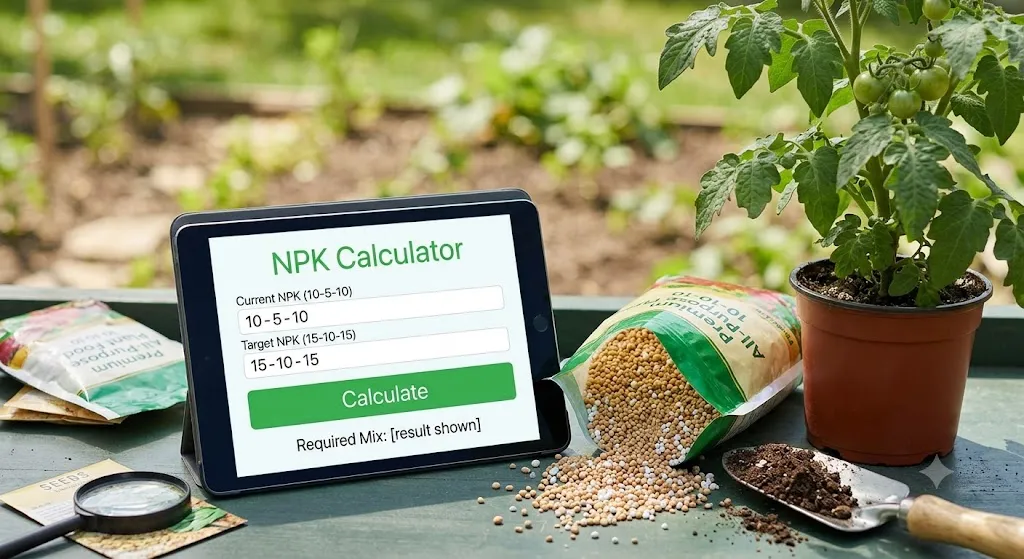
Every fertilizer recommendation in India is written in terms of three numbers: nitrogen (N), phosphorus written as P2O5, and potassium written as K2O. A card might read "120:60:40 kg/ha" or "50:25:12 kg per acre". Those are nutrients, not products – and the products on the shelf each contain only a share of them.
The NPK Calculator does the conversion the way an extension worker would on paper:
Phosphorus first. Phosphorus is usually supplied by DAP (46% P2O5) or SSP (16% P2O5), so we work that out first.
Credit the nitrogen in DAP. DAP is 18% nitrogen. That nitrogen counts towards the crop's N requirement, so we subtract it before calculating urea.
Urea for the rest. The remaining nitrogen comes from urea at 46% N.
Potash from MOP. Muriate of potash is 60% K2O.
You get the total quantity of each fertilizer for your whole field, plus the number of bags, so you know exactly what to pick up from the dealer. Because it credits the N in DAP, the urea figure is usually 15–25% lower than a quick "N ÷ 0.46" estimate – a real saving over a season.
If your recommendation includes a complex fertilizer such as 10:26:26 or 12:32:16, use the Fertilizer Requirement Calculator for that product, then come back here for whatever nutrient is still missing.
How to use the NPK Calculator
- 1 Enter your field area and pick the unit – acre, hectare, guntha, kanal or square metres all work.
- 2 Type the recommended doses of N, P2O5 and K2O from your Soil Health Card or crop recommendation. Choose whether they are per acre or per hectare.
- 3 Pick DAP or SSP as the phosphorus source. DAP is more common; SSP also supplies sulphur and calcium.
- 4 Press Calculate. You'll see kilograms of urea, DAP/SSP and MOP for the whole field, and how many bags to buy.
- 5 Split the urea as your crop schedule advises (for example, part at sowing and the rest at tillering or before flowering).
The formula we use
With the total nutrient needed for the field (dose per acre × acres):
DAP (kg) = P₂O₅ needed ÷ 46 × 100
N from DAP (kg) = DAP × 18 ÷ 100
Urea (kg) = (N needed − N from DAP) ÷ 46 × 100
MOP (kg) = K₂O needed ÷ 60 × 100
When SSP is used instead of DAP:
SSP (kg) = P₂O₅ needed ÷ 16 × 100
Urea (kg) = N needed ÷ 46 × 100
Sulphur supplied (kg) = SSP × 11 ÷ 100
The grades used are the standard Indian ones under the Fertilizer Control Order: urea 46% N, DAP 18% N and 46% P2O5, SSP 16% P2O5, MOP 60% K2O. Bag sizes are 45 kg for urea and 50 kg for the others.
Worked example
Suppose your recommendation for a 2-acre wheat field is 50 kg N, 25 kg P2O5 and 12 kg K2O per acre, and you plan to use DAP.
Total nutrients for 2 acres: N = 100 kg, P2O5 = 50 kg, K2O = 24 kg.
DAP = 50 ÷ 46 × 100 = 108.7 kg (a little over 2 bags).
Nitrogen supplied by that DAP = 108.7 × 18% = 19.6 kg.
Nitrogen still needed = 100 − 19.6 = 80.4 kg, so urea = 80.4 ÷ 46 × 100 = 174.9 kg (just under 4 bags of 45 kg).
MOP = 24 ÷ 60 × 100 = 40 kg.
If you had skipped the DAP credit and simply divided 100 kg N by 0.46, you would have bought about 217 kg of urea – roughly one extra bag you didn't need.
Things to keep in mind
The dose is the important part. This tool assumes the N:P:K numbers you enter are right for your crop and soil. Get them from a soil test, your state agriculture university's package of practices or the local agriculture officer.
Per acre vs per hectare. Recommendations printed in kg/ha are about 2.47 times bigger than the same dose in kg/acre. Double-check the unit before you calculate.
Too much N from DAP. For low-nitrogen crops such as pulses, DAP alone can supply more nitrogen than needed. The calculator warns you when that happens; SSP may suit better.
Organic manure counts. If you apply FYM, compost or vermicompost, your adviser may reduce the chemical dose. Enter the reduced figures.
Timing matters as much as quantity. Phosphorus and potash usually go in at sowing; urea is normally split. Follow the schedule for your crop.
Frequently asked questions
What does NPK 120:60:40 mean?
It means 120 kg of nitrogen (N), 60 kg of phosphorus as P2O5 and 40 kg of potash as K2O. Check whether the numbers are per hectare or per acre – most university recommendations are per hectare.
Why do you subtract the nitrogen in DAP?
DAP contains 18% nitrogen. If you apply 100 kg of DAP you have already given the crop 18 kg of N. Ignoring it means over-applying urea, which costs money and can cause lodging and pest problems.
Can I use SSP instead of DAP?
Yes. SSP has only 16% P2O5, so you need almost three times the weight, but it also supplies about 11% sulphur and some calcium – useful for oilseeds, pulses and sulphur-deficient soils. SSP has no nitrogen, so the full N requirement comes from urea.
How many bags of urea do I need per acre?
It depends on the dose. For 50 kg N per acre with DAP supplying some of it, you typically need about 1.8–2 bags (45 kg) of urea per acre. Enter your own dose above for an exact figure.
What if I use a 10:26:26 or 12:32:16 complex fertilizer?
Work out the complex fertilizer first with the Fertilizer Requirement Calculator, note how much N and K2O it supplies, subtract those from your recommendation, and enter the balance here.
Does this calculator work for kg per hectare?
Yes. Choose kg/ha next to each nutrient and pick hectares for the area. You can mix units – for example, dose per hectare and area in acres – and the calculator converts everything correctly.
Is the result a recommendation?
No – it is the arithmetic for the dose you enter. The right dose depends on the crop, variety, soil test, irrigation and season. Please confirm the dose with local agricultural guidance.
Guides that use this calculator
Last updated . Spotted a mistake or need a unit we don't support? Tell us.